

How boat detailing works
The standard came from Sunseeker. The methodology hasn't changed.
Before we touch a single surface
Every job starts with a full assessment. We photograph the boat, note its condition, and plan the work around what it actually needs: no guessing on products, no shortcuts. We read the gelcoat for oxidation, UV damage, thinning and burnt-through areas, and check for the things that quietly spoil a finish: mould and mildew, rust and tannin staining, hard-water spotting, hazing in the clears.
Anything of concern is taped, logged and photographed, and you're made aware of it before work begins. This protects you from unexpected repair costs, and it ensures we never overwork a surface that needs specialist attention rather than compounding. If we find a section too thin to safely compound, we tell you clearly and recommend the right next step, whether that's a lighter treatment or a specialist repair before detailing.
The promise is simple: we will never proceed in a way that risks further damage to your hull.
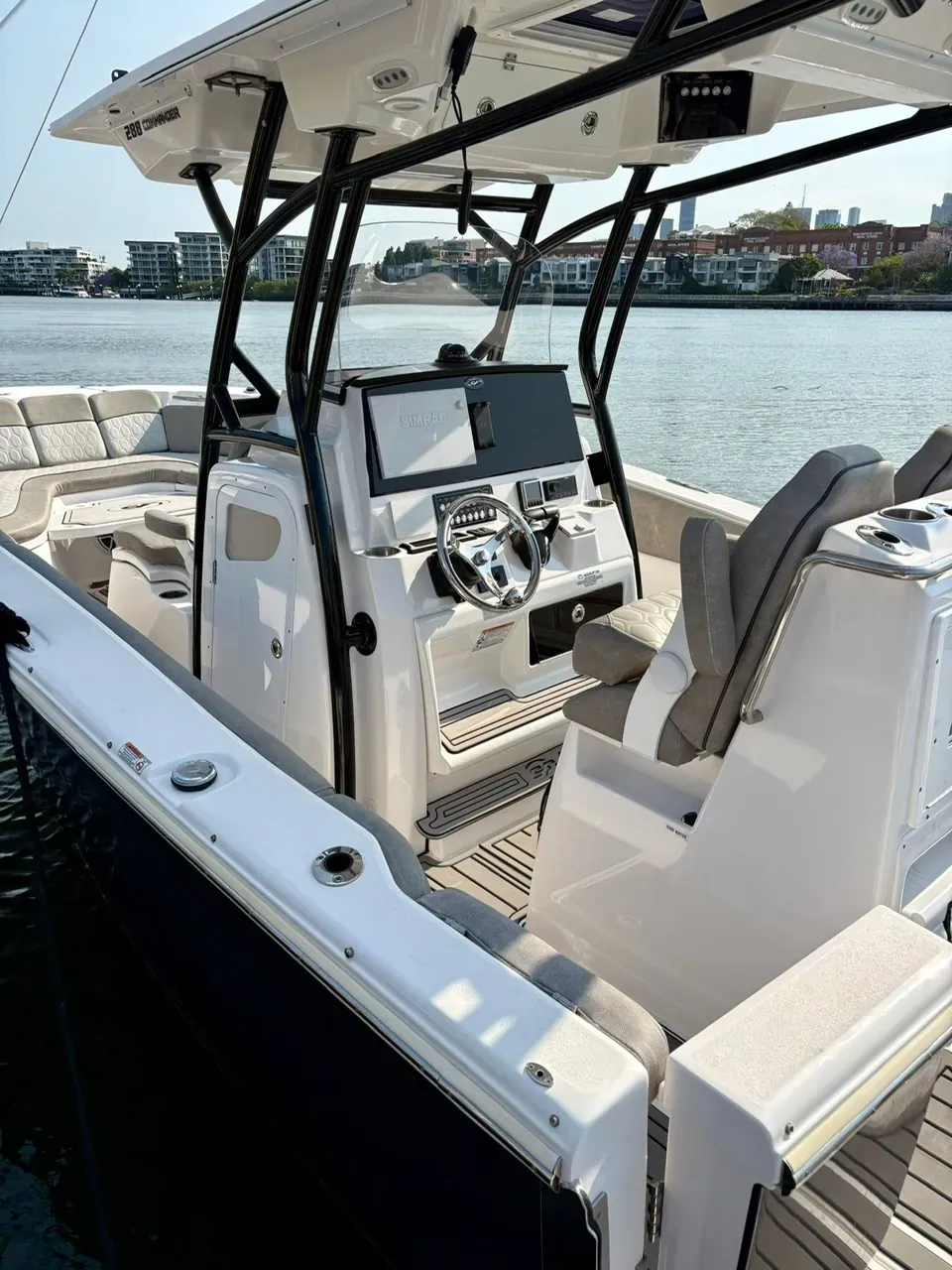
The work itself
Wash and decontaminate
This is the step most people rush, and it's the one that makes or breaks everything after it. Salt is abrasive. Left to dry on the gelcoat it doesn't just stain, it scratches the moment a cloth moves across it. So before anything touches the hull, we soak the boat in a marine pre-wash to lift and soften the salt, grit and grime, then wash from the top down by hand. We run the water through an inline filter, too. Brisbane's water is hard, and unfiltered it leaves mineral spotting as stubborn as the marks we came to remove. Where a boat needs it, this is also where we treat what a normal wash leaves behind: rust and tannin staining, mould and mildew, and hazing in vinyl clears.
Cut
This is the stage that brings a dull, chalky hull back to life. Using a machine and a cutting compound, we take off the thin top layer of oxidised, UV-damaged gelcoat to reveal the fresh, glossy surface underneath. The skill is in matching the work to the boat. Cut harder than a surface needs and you remove good gelcoat that can't be put back, so we read each section and use only what it calls for.
Polish
Cutting restores the surface; polishing refines it. A finer pass clears the fine marks the cut leaves behind and brings the finish to a deep, even gloss. Then we check it under direct light and go back over anything that isn't right.
Wax and seal
A freshly polished surface starts oxidising again almost straight away. UV, salt air and weather never stop. Wax and sealant lay down a protective barrier that takes that damage so the gelcoat doesn't. It locks in the gloss, beads water, and makes every clean after it easier.
Glass
Streak-free, properly degreased, with the right products for marine glass.
Basic interior
Cabin surfaces, seats, dash and panels, cleaned, dressed and conditioned. Not a full upholstery restoration (that's a separate job), but everything visible is brought up with the rest of the boat.
What we use
Everything we use is marine-grade, Australian-made, and safe to use on and around the water. We work on the waterways, and we take that seriously. The compounds are matched to the boat's condition rather than a one-size product; the waxes and sealants are UV-rated for the Queensland sun; the interior products feed vinyl and upholstery rather than drying them out. The product choices are part of the standard: we don't drop to cheaper alternatives that won't hold up to sun and salt.
Get a quote →After the Reset
Once we've done your Detail Reset and we know your boat, we can put a custom care package together. Visits scheduled around how often you're out on the water, your local conditions, and what your boat needs to stay at the Tide Standard.
A care package is never a rigid subscription. It's built around you: frequency, scope, and timing all flex with how you use the boat. Some customers want quarterly visits to keep things at the same baseline. Others want a single annual reset and a spring service before the season.
When you're ready to talk about ongoing care, we are.
Getting a boat ready to sell?
A pre-sale detail builds on everything above, plus the extra work a sale demands, so your boat survives a buyer's eye and shows its best in the listing photos.
See pre-sale detailing →Big boats
Where possible, we prefer to detail vessels out of the water.
This gives us full access to the hull, including below the waterline, the keel and running gear, and allows us to carry out a more complete and consistent job.
If your boat is already coming out of the water for antifoul, repairs, survey or other major works, we can coordinate the detail around that schedule. This is often the best time to complete the work, as access is easier and the result is more thorough.
That said, haul-out is not always necessary. We can detail many vessels while they remain in the water, particularly when the focus is on the topsides, deck, glass, stainless, interior and general presentation.
The main limitation is access. If the boat stays in the water, we cannot properly clean or detail below the waterline, the keel or running gear.
For larger vessels, the work is always quoted individually after an in-person inspection. Bigger boats require more product, more time, and in many cases scaffolding or additional access equipment to achieve full topside coverage. There is no simple per-foot rate that properly reflects the work involved.
Detailing FAQs
What is a Detail Reset?
A Detail Reset is the first job for every new detailing customer. We come to your boat, assess what it needs, and bring it up to the Tide Standard: wash, cut and polish, wax and buff, glass, basic interior. Once we know your boat, we can build a cost-effective custom care package around how you actually use it.
How often should I have my boat detailed?
As a general guide: wash after every outing, wax every 3–6 months, and a full compound and polish once a year or when the hull starts looking dull. We can build a custom care package around how you actually use your boat so you never have to think about it, and it's more cost-effective long-term.
What's a custom care package?
Once we've done your Detail Reset and we know your boat, we can put a custom care package together, with visits scheduled around how often you're out on the water, your local conditions, and what your boat needs to stay at the Tide Standard. It's never a rigid subscription. We build it around you.
Do you work on big boats differently?
Yes. Typically, vessels 20ft and over are detailed out of the water for full access. Allied with your other service providers, we like to schedule these details for the same time your boat is being antifouled or undergoing other necessary maintenance. Alternatively, the detail will be performed whilst in the water. Quotes are always provided individually after an in-person inspection.
Do you use environmentally friendly products?
Yes. Everything we use is marine-grade, Australian-made and safe to use on and around the water. We're working on the waterways, and we take that responsibility seriously.
Why don't you list detailing prices on the website?
Because every boat is different, and every owner uses their boat differently. A Detail Reset on a well-maintained 5-metre runabout is a very different job to one on a neglected 30-foot cabin cruiser. We quote on what your boat actually needs, never a flat per-foot rate. That's how we keep the standard honest.
How do I get a quote?
Send us a few photos and a quick description via the enquiry form on the detailing page, call us on 0485 670 603, or email hello@tideclub.com.au. We'll come back with a quote within 24 hours. For larger boats, we may need an in-person inspection before quoting.
Start your Detail Reset
Send us a few photos and a quick description, and we'll come back with a quote within 24 hours.